

Ahadu Asres Legesse is a senior project manager in business operations from Anoka, Minnesota, with more than 28 years at Target, U.S. Bank, Medtronic and UnitedHealth Group. Much of his career has centered on one problem every organization faces: getting people to adopt a new system or procedure. His approach starts with the people who do the work, gathering their input before, during and after a change. For teams that run surveys, his method translates into a simple feedback cycle that can show whether a change is actually working.
Organizations spend heavily on new systems, new procedures and reorganized workflows. Then many of them discover, weeks after launch, that employees have quietly gone back to the old way. The tool was fine. The plan looked sound. What was missing was an accurate picture of how the work really got done, and of how the people doing it felt about the change.
That gap is where Ahadu Asres Legesse has spent much of his career, and it is why his approach is worth studying for anyone who uses feedback to make better decisions.
Who Is Ahadu Asres Legesse?
Legesse is a Senior Project Manager in Business Operations at UnitedHealth Group in Minnetonka, Minnesota, a role he has held since 2020. He leads cross-functional projects that improve internal operations, technology adoption and administrative workflows, coordinates operations, IT and business support teams, and mentors junior project coordinators.
Before that, he spent nearly eight years as a Project Manager in Operational Excellence at Medtronic in Fridley, Minnesota (2012 to 2020), eight years as a project coordinator and then project manager at U.S. Bank (2004 to 2012), and six years as an operations analyst and project support specialist at Target Corporation (1998 to 2004). He holds a Bachelor of Science in Business Administration from Metropolitan State University. More about his background is on his about.me profile.
What Problem Does His Work Solve?
The research on this problem is consistent. In Prosci’s Best Practices in Change Management study of more than 2,600 practitioners, 88 percent of projects with excellent change management met or exceeded their objectives, compared with 13 percent of projects with poor change management.
Communication is part of the same story. The Project Management Institute’s 2013 Pulse of the Profession research on communications estimated that about $75 million of every $1 billion spent on projects was put at risk by ineffective communication.
Both findings point to the same blind spot. Projects fail less often on technology than on people: what they understand, what they believe and whether anyone asked them.
The Core Insight: Ask the People Who Do the Work
At Medtronic, much of Legesse’s work involved reviewing how teams completed their daily tasks, identifying delays or unnecessary steps and recommending practical improvements. That kind of review depends on input from front-line employees, because the official procedure and the real one are rarely identical. People rely on workarounds, side spreadsheets and informal handoffs that never appear in a process document.
His projects also did not stop at recommendations. They included supporting employees through the transition, updating documentation and helping teams adjust to new ways of working. At UnitedHealth Group, supporting the introduction of new business systems and procedures, from implementation planning to helping teams adjust after launch, remains a core part of his role.
The principle underneath both roles is the one he describes as the foundation of good project management: people should understand what needs to be done, who is responsible and when it is expected. Feedback is how a project manager finds out whether that understanding actually exists.
How Does This Translate Into a Feedback Cycle?
For SurveyNow readers, the most useful lesson is that feedback is not a one-time event. It works best as a short cycle tied to the stages of a change. The structure below applies Legesse’s approach to the way teams can gather feedback with simple surveys:
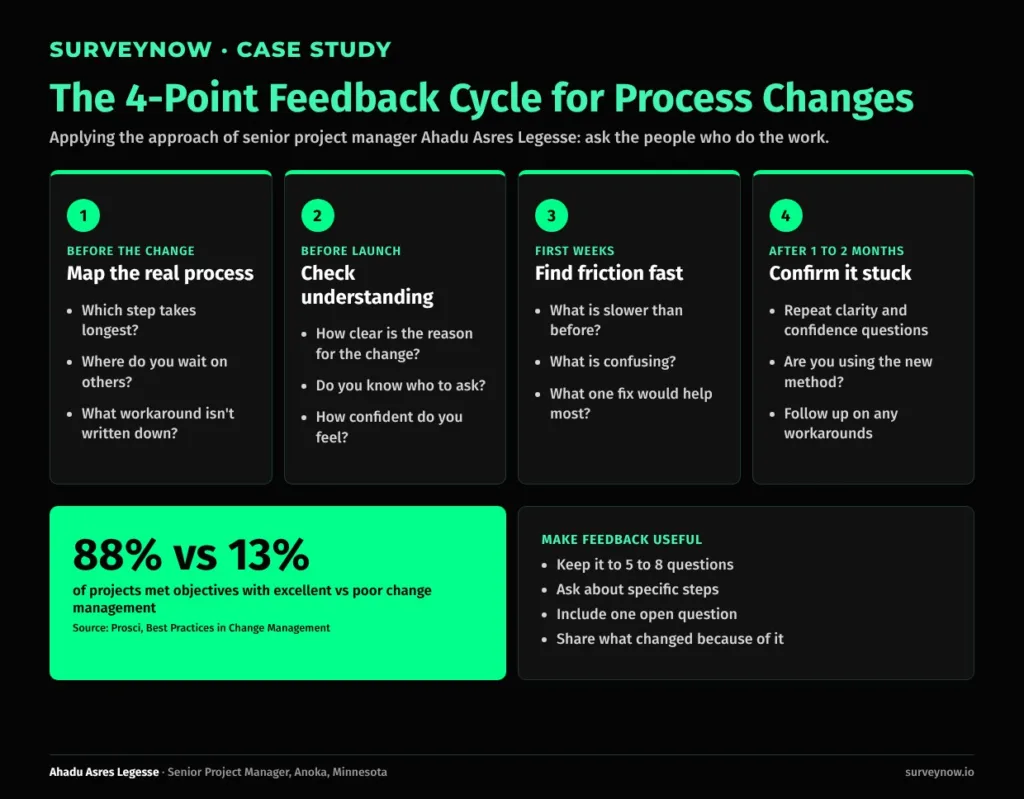
1. Before the change: map the real process
Ask employees how the work actually gets done today. Useful questions include: Which steps take the most time? Where do you wait on someone else? What workaround do you rely on that is not written down? This is the input that keeps a new process from breaking the things people quietly depend on.
2. Before launch: check understanding
A short readiness check shows whether people know what is changing, why and what it means for them. Ask them to rate how clear the reason for the change is, whether they know who to ask for help, and how confident they feel about the new steps.
3. After go-live: find friction fast
In the first few weeks, a quick pulse survey catches problems while they are still small, which reflects Legesse’s preference for solving problems early rather than letting them become larger delays. Ask what is slower than before, what is confusing and what one fix would help most.
4. After a month or two: confirm it stuck
Repeat a few of the earlier questions. If clarity and confidence scores rose, the change is taking hold. If people report using the old method, follow up before the workaround becomes permanent.
What Makes Feedback Actually Useful?
- Keep it short. Five to eight questions respect people’s time and get more honest answers.
- Ask about specific steps. “How long does approval take?” produces better data than “How do you feel about the process?”
- Include one open question. The most useful insight often arrives in a single sentence of free text.
- Close the loop. Tell people what you heard and what changed as a result. Teams that never see results stop responding.
- Report it with the project. Add a one-line feedback summary to regular status updates so leaders see adoption, not just milestones.
What Can Other Project Managers Learn From This?
Legesse’s career shows that the most reliable project managers are often the most attentive ones. One of the topics on his Steady Progress Podcast puts it plainly: good project management starts with listening. Surveys are one practical way to listen at scale, especially when a change affects more people than a project manager can talk to one by one.
The lesson is not that every project needs a large research effort. It is that every change needs a way to hear from the people it affects, early enough to act on what they say.
The Takeaway
Process changes rarely fail because the new system is wrong. They fail because no one checked how the work was really done, whether people understood the change, or whether the fix actually stuck. Ahadu Asres Legesse built a 28-year career on closing those gaps. A short, well-timed feedback cycle gives any team a way to do the same.
For more profiles of professionals and how they work, explore our case studies and interviews, including our case study on how Brian Vientos delivers 98% of his projects on time. To build your own change-readiness or pulse survey, see a SurveyNow demo.
Frequently Asked Questions
Who is Ahadu Asres Legesse?
Ahadu Asres Legesse is a senior project manager in business operations based in Anoka, Minnesota, with more than 28 years of experience at Target, U.S. Bank, Medtronic and UnitedHealth Group.
Why do process changes fail?
Most fail because of people, not technology: employees were not consulted about how the work really happens, did not understand the reason for the change, or lost support after launch.
When should you survey employees during a change?
At four points: before designing the change, shortly before launch, in the first weeks after go-live and again after a month or two to confirm the change has stuck.
How long should a change feedback survey be?
Short. Five to eight focused questions, including one open-ended question, usually produce more honest and useful answers than a long survey.

